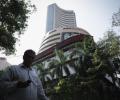
Indian benchmark indices, Sensex and Nifty, closed higher, primarily driven by bank stocks and encouraging US inflation data, which fuelled expectations of a less aggressive Federal Reserve monetary policy. However, escalating US-Iran hostilities tempered investor sentiment, leading to some profit-taking.

The Rajya Sabha has passed The Bankers' Books Evidence Bill, 2026, which aims to replace a British-era law and allow digital and virtual records to be admissible as evidence in courts. This legislation aligns with contemporary digital banking practices and extends a uniform evidential framework to various financial entities, including NBFCs and fintech companies. Finance Minister Nirmala Sitharaman highlighted the bill's role in strengthening public confidence and safeguarding customer privacy. The bill's passage, however, saw an Opposition walkout over unrelated issues.

The combined market valuation of five of India's top-10 most valued firms eroded by Rs 1 lakh crore last week, with IT giant Tata Consultancy Services (TCS) experiencing the largest decline amidst a bearish trend in domestic equities.

'Giving up is very easy. But don't give up. Try out whatever you can. Something will happen.'

Indian benchmark indices, Sensex and Nifty, closed nearly flat on Thursday, influenced by the US Federal Reserve's interest rate hike and indications of further monetary tightening. Despite some intraday gains, caution prevailed, with foreign institutional investors continuing to offload equities. Meanwhile, the National Stock Exchange of India's (NSE) mega initial public offering opened for subscription, garnering 39 per cent subscription on its first day.

Indian benchmark indices, Sensex and Nifty, closed lower, primarily due to a downturn in banking and financial stocks, coupled with crude oil prices remaining above USD 80 per barrel. Geopolitical uncertainties and new regulatory proposals for the non-bank lending sector also contributed to cautious investor sentiment.

"Pressure on the current account is a temporary problem. Sooner rather than later, our external sector will improve," said RBI Governor Sanjay Malhotra.

Despite aggressive expansion, India's solar power sector faces significant hurdles from rising regional disparities in installed capacity and a looming manufacturing glut due to overcapacity in domestic solar equipment production, potentially leading to consolidation and pricing pressures.

A joint report by Dell Technologies and Zinnov reveals that despite high ambition, nearly 70% of India's Global Capability Centres (GCCs) are stuck at the pilot stage for AI adoption. Foundational gaps in data, infrastructure, and governance are identified as key bottlenecks preventing the scaling of AI initiatives into enterprise-wide production. The report highlights the need for significant reskilling of the workforce and robust foundations for industrialising AI responsibly.

RBI Deputy Governor Rohit Jain highlighted that banks are well-positioned to deploy $133 billion mobilised through FCNR(B) deposits, especially with strong credit demand ahead of the festival season, while also stressing the importance of robust technology governance and cyber defences in the financial sector.

Indian benchmark indices Sensex and Nifty tumbled nearly 1 per cent for the third consecutive day, driven by a sharp spike in crude oil prices and significant selling in bank stocks, with Brent crude jumping to USD 95.27 per barrel.

The Economic Offences Wing (EOW) of the Crime Branch Jammu has filed a chargesheet against two individuals, Manoj Kumar and Vikram Singh, in a financial fraud case involving over Rs 1.22 crore collected from investors in Samba district. The accused allegedly induced residents to invest in schemes from unregistered or de-registered NBFCs, promising high returns but failing to deliver.

A report by IIT-Bombay professors recommends reducing the Merchant Discount Rate (MDR) on UPI transactions from 0.40 per cent to 0.08 per cent. It suggests that banks should fund the UPI ecosystem using their net interest margins from CASA deposits, rather than relying on MDR. The report also addresses transaction costs, credit card MDR, and ATM withdrawal allowances, aiming to ensure UPI's long-term sustainability and public trust by proposing remuneration only from large merchants.

RBI Governor Sanjay Malhotra reiterated India's cautious stance on cryptocurrencies due to concerns over monetary sovereignty and capital flows, while actively promoting underlying technologies like distributed ledger technology and tokenisation. He also addressed the global rise in public debt and hardening bond yields, attributing it to increased government and private spending, including that driven by AI, and noted the implications of global interest rates on India's monetary policy.

Indian benchmark indices, Sensex and Nifty, extended their losses for a second consecutive day, primarily due to HDFC Bank's disappointing quarterly earnings and escalating tensions in West Asia, coupled with persistent foreign fund outflows.

A widow in Kanpur has alleged that jewellery worth approximately Rs 50 lakh vanished from her State Bank of India (SBI) locker, leading police to register an FIR against the branch manager and unidentified staff members. The complainant, Rashmi Arora, discovered the locker empty after a period of non-operation and a bank merger.

Kerala Police have issued a warning against online fraudsters selling fake tickets for the upcoming India-West Indies first ODI match in Thiruvananthapuram. Scammers use social media to lure victims, collect personal details, and demand multiple payments under various pretexts, advising the public to only use official booking platforms.

Indian benchmark indices, Sensex and Nifty, closed marginally lower due to elevated crude oil prices, fresh US-Iran tensions, and expectations of a tighter monetary policy from the US Federal Reserve, despite strong domestic GDP growth.

The Enforcement Directorate has arrested Pravin Shinde and Brijesh Moradiya in a money laundering investigation connected to international drug trafficker Salim Ismail Dola's syndicate. The probe revealed a highly organised network involved in manufacturing and trafficking mephedrone, using hawala channels to layer proceeds of crime and acquire assets.

'It's not about individuals operating the mule accounts being more or less skilled. Instead, 'lower-level' refers to the role the individual account plays in the broader mule network.'
American coach Dave Cousins, who led India's compound archers to a historic Olympic quota at the Asian Games, faced a significant delay in receiving his salary for over three months. The Archery Association of India and Sports Authority of India have acknowledged the issue, attributing it to a technical problem, and assured that the payment will be cleared within days, resolving the coach's threat to quit.
The Reserve Bank of India (RBI) is planning to extend tokenisation to various financial asset classes, building on its successful trials with certificates of deposit (CDs). This move aims to enhance the efficiency of issuance, trading, and settlement of financial assets, leveraging blockchain technology and wholesale Central Bank Digital Currency (CBDC) for atomic settlements.

The Kerala Legislative Assembly has passed a motion urging the central government to completely withdraw the proposed Merchant Discount Rate (MDR) on UPI transactions exceeding Rs 2,000. Chief Minister V D Satheesan and CPI MLA K Rajan highlighted concerns that the MDR would increase business costs, harm small businesses, and reduce the appeal of digital payments, while the BJP argued it would not affect general public or small merchants.

India is making a significant push to establish itself as a global semiconductor manufacturing hub, driven by strategic investments and policy support. The upcoming SEMICON India 2026 event will showcase the country's advancements and ambitions in this critical industry, which underpins virtually all modern electronic devices and has faced global supply chain vulnerabilities.

The Supreme Court has issued a directive for the Shri Banke Bihari Temple in Vrindavan, mandating that all donations must be deposited into official donation boxes or the online temple treasury. This comes amidst serious allegations of sevayats siphoning off funds and obstructing online donation methods, highlighting the need for a transparent mechanism in temple management.
Union Finance Minister Nirmala Sitharaman expressed strong confidence in India achieving over 10 per cent economic growth, advocating for increased technology adoption and innovation. She urged overcoming scepticism and highlighted technology's transformative role in agriculture and public sector reforms, while also launching a new fund and book at an IIT Madras event.

The CBI has filed a closure report in the 2002 disinvestment of Hindustan Zinc Ltd, stating that allegations of irregularities could not be substantiated. This comes despite a 2022 Supreme Court directive by then-CJI D Y Chandrachud to register a regular case, citing sufficient material and concerns over undervaluation and the role of a global advisor. The special court will now decide on the report.

The GST Council, chaired by Finance Minister Nirmala Sitharaman, has begun deliberations on significant reforms, including decriminalising nine offences, softening provisions for 24, and raising the threshold for criminal prosecution to Rs 5 crore. The proposed changes also include scrapping the arrest powers of GST officers and introducing an 'invoice matching system' to combat fake input tax credit claims, aiming for a trust-based taxation approach and enhanced ease of doing business.

Mizoram police have successfully recovered over Rs 1 crore for cybercrime victims this year and arrested nine alleged cybercriminals. The state has also established a dedicated State Cyber Crime Coordination Centre (S4C) to enhance its efforts in detection, investigation, and public awareness against cybercrime.
The Reserve Bank of India (RBI) has introduced a new framework allowing banks to offer differential interest rates on bulk deposits based on their liquidity characteristics under the Liquidity Coverage Ratio (LCR) framework, while maintaining the principle of uniform pricing across similar deposits.

India's markets regulator Sebi has launched 'Demat 2.0', a pilot project for tokenisation of corporate bonds, enabling atomic settlement through integration with RBI's wholesale CBDC. This new market infrastructure uses Distributed Ledger Technology (DLT) to make bond issuance, trading, and settlement faster and more efficient. India is the first country to issue corporate bonds natively on a distributed ledger with central bank digital currency settlement. Additionally, RBI Governor announced new UPI innovations: 'Tap & Pay' for faster POS transactions and MyUPI, an AI-powered customer support solution.

India's private sector capital expenditure is projected to reach approximately 3.2 trillion in the financial year 2026-27, up from 2.6 trillion in FY26, according to a Reserve Bank of India bulletin report, indicating sustained confidence despite global uncertainties.

The Reserve Bank of India (RBI) net purchased a record $18.65 billion in July, driven by inflows from its concessional swap facility, leading to a significant increase in India's foreign exchange reserves.

A report by Scholars at Risk, 'Free to Think 2026', states that academic freedom in India is "severely restricted" due to increasing government influence over higher education, university governance, and curbs on student expression. India is listed among six countries in this category, with its Academic Freedom Index score sharply declining. The report cites instances of faculty dismissals, event cancellations, and pressure on student protests, highlighting the alleged use of the UGC as a vehicle for state influence.

'Every period of excessive optimism eventually gives way to a correction, while periods of extreme pessimism often create the best investment opportunities.'

Prime Minister Narendra Modi has urged for a global framework to combat cross-border cyber frauds and deepfakes, highlighting the need for governments, tech companies, telecom operators, and financial institutions to collaborate. Speaking at the India Mobile Congress 2026, Modi stressed that technology thrives on trust and that India is ready to share its expertise in tackling cyber threats. He also noted the rapid expansion of 5G and the success of digital governance initiatives like Direct Benefit Transfer.
UPI transactions saw a 27% volume increase and 20% value increase in the first half of the current fiscal year. Despite a slight moderation in September, the digital payment system is set to implement a 0.4% merchant discount rate on transactions over Rs 2,000, aiming for a sustainable revenue model. Small merchants and person-to-person payments remain exempt, and UPI's global presence continues to expand.

India is actively integrating payment system harmonisation into its Free Trade Agreement (FTA) negotiations, especially with countries hosting a large Indian diaspora. This strategy aims to leverage India's growing fintech ecosystem, facilitate cross-border financial services, and position India as a global hub for financial services exports, particularly through platforms like GIFT City.

Economists widely anticipate the Reserve Bank of India's Monetary Policy Committee will increase the repo rate by 50 basis points, likely split between the October and December meetings, as retail inflation is projected to peak at 6.1 per cent in the third quarter, exceeding the RBI's tolerance limit.
The Enforcement Directorate has attached assets worth approximately Rs 112.90 crore, including a residential property in Texas, USA, in a money-laundering case. The case involves a Noida-based air-conditioner components manufacturer, LEEL Electricals Limited, and its promoters, accused of defrauding a consortium of banks led by SBI of Rs 376 crore through manipulated financial statements and siphoning off funds.
